

La Carmina is a name that’s hard to forget, even if you’re hearing it for the first time. This Canadian is known far beyond her home country as a blogger, author, TV host, and one of the leading figures in alternative fashion. Her signature style is a blend of goth, Japanese street culture, and vibrant individuality. Learn more at vancouveriski.
How the Blog Started and What It’s About
La Carmina was born in Vancouver, a city many see as a symbol of coziness, tranquility, and eco-friendliness. But in her life, there has always been room for boldness, rebellion, and creativity. She grew up surrounded by a mix of Western culture and a fascination with Japan, which later became the foundation of her personal style and blog. She attended prestigious schools, first studying at Columbia University and later earning a law degree from Yale University. In the end, however, she chose a completely different path.
In 2007, La Carmina launched a blog that stood out from the start. She wrote about gothic fashion, Japanese subcultures, alternative cafes, and ways to express oneself—everything that challenged the mainstream. She didn’t just post photos or media; she built a world that you wanted to dive into and explore. The blog’s popularity skyrocketed. Her unique style and subject matter caught the attention of major media outlets, with features in The New York Times, Boing Boing, and WWD—and that’s just a small sample. In 2016, she was named the author of the “Best Blog of the Year” by Auxiliary Magazine. And it all started not in a studio or on a TV show, but with a laptop, a love for subcultures, and the desire to be herself.

From Blogging to a Career in Journalism
As mentioned, once La Carmina’s blog gained traction, her bold approach attracted not only readers but also editors from major media companies. It wasn’t long before she transitioned from being a well-known online personality to a professional journalist on television screens. And she wasn’t working for just anyone, but for publications considered to be industry benchmarks. Her work has been featured in The New York Times, Travel + Leisure, National Geographic, Time, and Business Insider, among others.
And it certainly wasn’t just luck. La Carmina not only knows how to tell a compelling story but also has a talent for finding the extraordinary in the ordinary. Her articles are never cliché because she doesn’t just list facts. Instead, she uncovers deeper meanings, revealing the ideas behind places, the beauty they convey, and the symbols they hold.

In 2020, La Carmina received the prestigious Bronze Award from the SATW Lowell Thomas Awards for travel journalism—a recognition that confirms her work holds real value in the media world.
In addition to her articles, La Carmina has authored several books that continue to explore her interests. For instance, in “Cute Yummy Time” (2009), she showed readers how to creatively plate food in the style of Japanese characters. In “Crazy, Wacky Theme Restaurants: Tokyo” (2009), she explored Japan’s most extravagant theme establishments. And in “The Little Book of Satanism” (2022), she took on the task of debunking the myth that Satanism has anything to do with its popular, misconstrued image.
Work in Television and Production
It’s also easy to imagine La Carmina as a character in a movie or even as the host of her own show. And, in fact, that’s what she became. Television is one of the most significant parts of her career, where she showcases her unique style, cultural knowledge, and incredible charisma. Although her media journey began with a blog, not a TV set, it wasn’t long before major networks started inviting her to work with them, drawn by her expertise in Japanese culture, subcultures, and alternative fashion. Soon enough, she appeared in over 120 television projects worldwide, including news segments, travel shows, and documentaries, often serving as a content consultant, producer, or concept creator.
Some of her most notable projects include appearances on shows for Discovery, Travel Channel, and National Geographic, as well as on Japanese television programs where she often discusses Tokyo’s street fashion or unusual food trends. For example, on the Science Channel’s Oddities, she introduced viewers to peculiar Japanese household items. On Bizarre Foods, she joined host Andrew Zimmern to taste dishes you’d be hard-pressed to find on a typical restaurant menu.
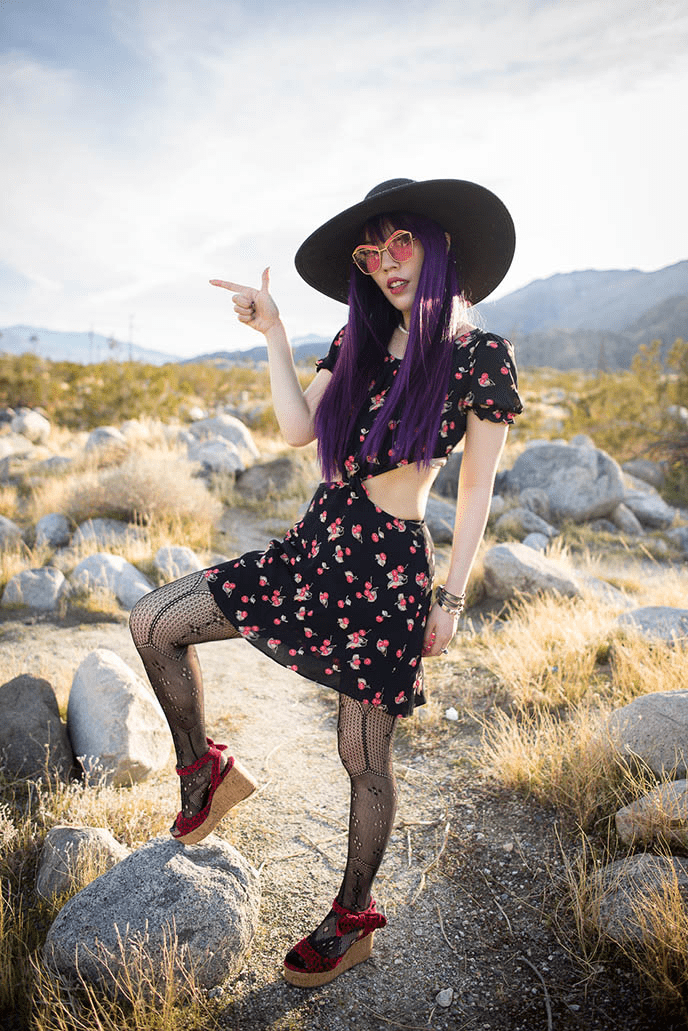
Production is another key area of her work. La Carmina founded her own production company that specializes in cultural research and filming in Japan. She collaborates with international crews, helping them with location scouting, finding on-screen talent, adapting scripts, and explaining local customs. This goes beyond simple translation; she essentially acts as a cultural bridge between Western audiences and Eastern contexts. Thanks to her, some well-known Western programs have been able to seamlessly integrate Japanese culture into their stories. On screen, La Carmina is always recognizable. Her look is striking yet effortless. But what truly captivates audiences is that she always remains true to herself. It’s one of the main reasons she’s so memorable.
The world of television is just one chapter in her vibrant creative story, where journalism, fashion, food, and subcultures intertwine. But it is on screen that she masterfully shows how to be unique while connecting with viewers from all over the world.

Worldview and Philosophy
Of course, those who don’t know her well might mistake her for a typical travel influencer collecting likes on beach photos. However, her life philosophy is much deeper. She doesn’t chase after cliché tourist spots or follow standard guidebooks. She’s not interested in crowded museums but in basement clubs, underground scenes, tiny boutiques, graffiti-covered walls, and the people who create a city’s cultural alternative. Goth, punk, visual kei, and a heavy dose of Japanese street glam—this is the style through which she expresses her unique way of seeing the world. La Carmina isn’t afraid to be bold, different, or “weird.” And that’s precisely why she attracts others who are also searching for something authentic, beyond the confines of the mainstream and its tired ideal of perfection.
In her travels, she pays special attention to what is often ignored: alternative art spaces, independent design studios, and local communities that live by their own rules, outside of mass culture. She writes about Berlin’s club scene, fetish festivals in Japan, niche culinary trends in Seoul, and the transformation of gothic cafes in Budapest. Her stories are always about people, the spirit of a place, and the freedom of self-expression.
Meanwhile, her blog and books serve as a platform to show that every culture has something fascinating and unique, even if it doesn’t seem so at first glance. As she says, “I hope to share all the meaningful stories of Japanese alternative culture,” because she wants to spotlight the important things that rarely make headlines…
Ultimately, her story shows that it’s possible to combine your passions, creativity, and work to inspire thousands of people around the globe. La Carmina has proven that you can be true to yourself while constantly discovering something new. And that is what makes her such an important figure in today’s media landscape.