

Born in Vancouver, Julia Kent later moved to New York. She grew up in a musical family; her mother enjoyed playing the violin, as did her sister, who went on to build a successful career as a classical musician. Julia’s parents were the ones who suggested she try the cello. So, while she may not have chosen the instrument entirely on her own, it has become an inseparable part of her life. And Julia is more than happy with it. According to her, the cello’s greatest strength is its range, which is remarkably similar to the human voice. Learn more at vancouveriski.
Leaving the Classical World Behind
To master the cello, Julia Kent started music school at a young age. This gave her a strong foundation and introduced her to the world of classical music, but she had no desire to continue down that path. The classical music scene is fiercely competitive and demands relentless work. Julia didn’t count herself among those musicians, feeling she lacked the raw talent and couldn’t see a future for herself in the genre.
After graduating, the cellist set her instrument aside for several years. It was her move to New York that reignited her passion for music. Stepping away from classical compositions, she began to improvise. Discovering these new abilities inspired Julia to approach the cello with fresh creativity and develop her own unique musical style.
Collaborations and Bands
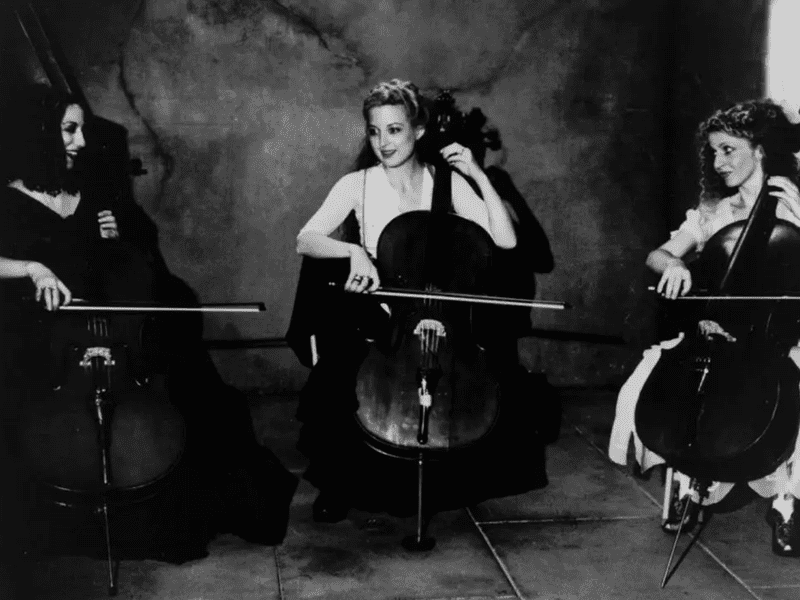
In New York, Julia became an editor at the weekly newspaper, The Village Voice. One day, Melora Creager reached out to the paper with an ad, looking for cellists to form her own band. Julia was one of the first to audition and was welcomed into the group. The initial nine-member ensemble was eventually trimmed down to a trio of women. They named the band “Rasputina,” after one of Creager’s songs. The group became a local favourite in New York, often performing their signature “gothic chamber pop” while dressed in Victorian-era costumes.
In the 2000s, Julia joined Antony and the Johnsons. She appeared on most of the band’s releases, starting with their 2001 EP, I Fell in Love with a Dead Boy.
Forging a Solo Career
After years of working with other musicians, Julia released her debut solo album, Delay, in 2007 on Important Records, where she combined cello playing with digital looping. Above all, the cellist loves the independence of solo performances and the ability to command the audience’s full attention. At the same time, performing on stage alone requires immense concentration. Her movements are polished and fluid, allowing her to coordinate her cello playing with the creation of musical loops and the addition of electronic sounds. You might also notice that she always performs barefoot. This is because she uses a MIDI pedal that demands a certain sensitivity and touch. Julia has grown accustomed to her bare feet, though she admits the only downside is that they get cold quickly.
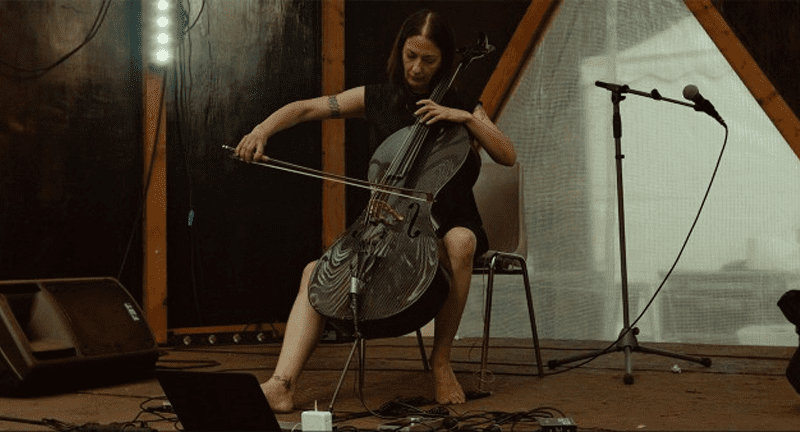
Julia loves to create music in the intimate atmosphere of her own studio. Often, the very process of creating something new sparks inspiration for her work and experiments. The cello isn’t the only instrument she works with. She also uses a program called Sooperlooper for looping melodies and adds various electronic sounds from Ableton. This looping technique helps her bring diverse musical ideas to life without needing to involve other musicians.
Additionally, Julia has also composed music for several films. For example, her composition “Dorval” was used in the 2008 documentary Trinidad, and “Gardermoen,” from her debut album Delay, was featured in Paolo Sorrentino’s film This Must Be the Place.